What is Offset in Supertrend Trading.I spent eight months using the Supertrend indicator without touching the offset setting once.
Not because I understood it and decided it wasn’t useful. Because I didn’t know it existed. I’d added Supertrend to my charts, left everything on default, and assumed the default settings were somehow optimal for every market and every timeframe I traded.
The signals were okay. Not great. I kept getting stopped out just slightly early — the indicator would flip, I’d enter, and then price would reverse back and continue in the original direction before finally making the move I’d anticipated.
Frustrating doesn’t cover it.
Then one evening I was going through TradingView’s indicator settings more carefully — just poking around really — and I noticed something I’d never paid attention to. The offset input field. It was set to zero. And when I hovered over it, the tooltip said something about shifting the indicator visually on the chart.
I changed it experimentally. The line moved. The signals shifted.
Something clicked.
That evening I spent four hours backtesting different offset values on the pairs I traded most frequently. What I found completely changed how I used Supertrend — and explained a lot of the early exits that had been eating into my results for months.
Let me walk you through everything I learned, because this is one of those settings that most traders either ignore completely or misunderstand, and it makes a genuinely meaningful difference once you understand it properly.
What Supertrend Actually Is — A Quick Refresher
Before getting into offset specifically, let me make sure we’re on the same page about what Supertrend does, because understanding the offset only makes sense if you understand the base indicator first.
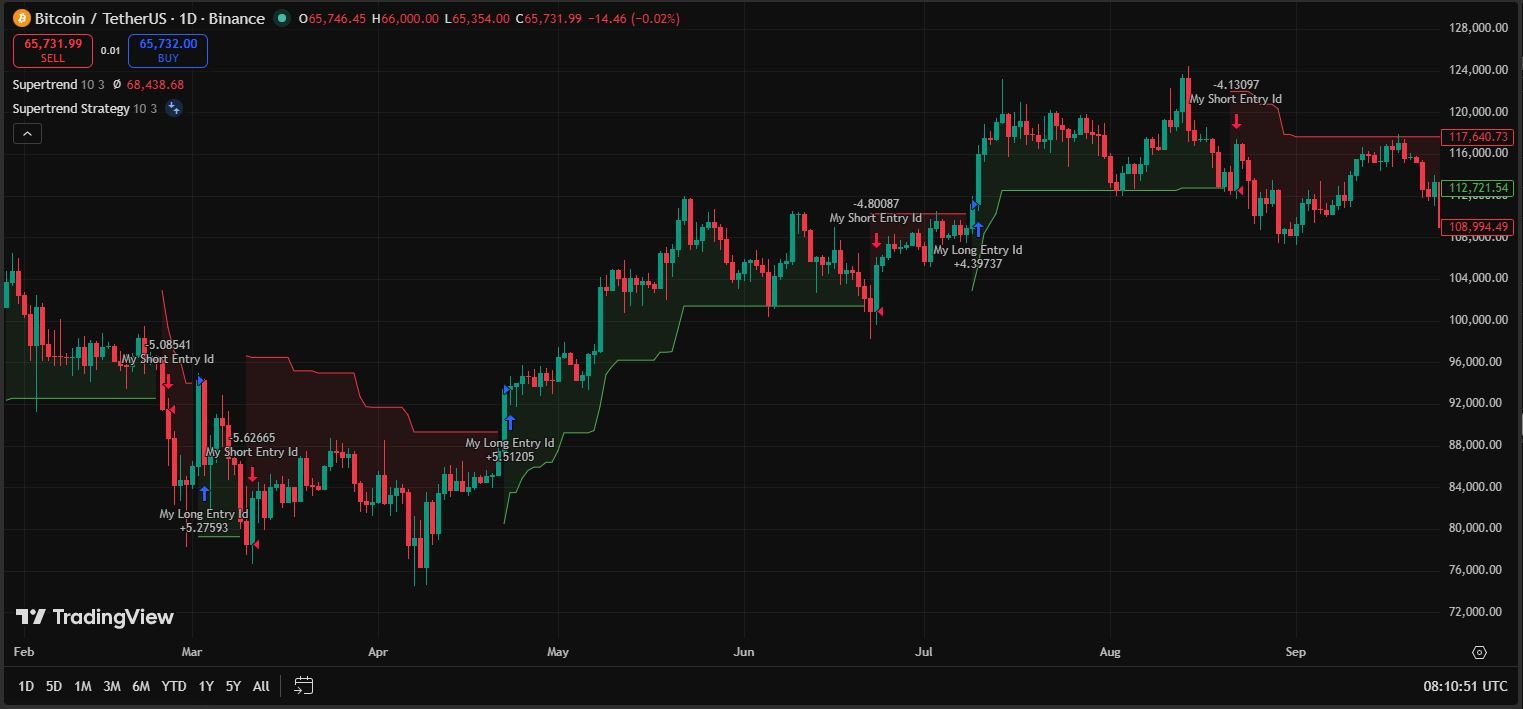
Supertrend is a trend-following indicator built on two inputs: the ATR (Average True Range) period and a multiplier. It plots a line above or below price that changes color — typically green when price is in an uptrend, red when in a downtrend.
When price closes above the Supertrend line, the indicator flips green and signals a potential long entry. When price closes below it, the line flips red and signals a potential short entry or exit.
It’s one of the cleaner trend indicators out there because it adapts to volatility through the ATR component. In a volatile market, the line sits further from price. In a quiet market, it sits closer. This makes it more dynamic than a simple moving average.
The default settings on most platforms are ATR period 10, multiplier 3. These aren’t magic numbers — they’re just reasonable starting points that work across many markets.
And then there’s the offset. Which almost nobody talks about.
What Offset Actually Means in Supertrend
Here’s the simplest explanation I can give you.
The offset setting shifts the Supertrend line horizontally on your chart. A positive offset moves the line to the right — into the future. A negative offset moves it to the left — into the past.
That’s it mechanically.
But the implication is more interesting than it sounds.
When you apply a positive offset — say, offset 2 — the Supertrend line you see plotted on the current candle is actually the Supertrend value calculated two candles ago. You’re seeing a delayed version of the indicator.
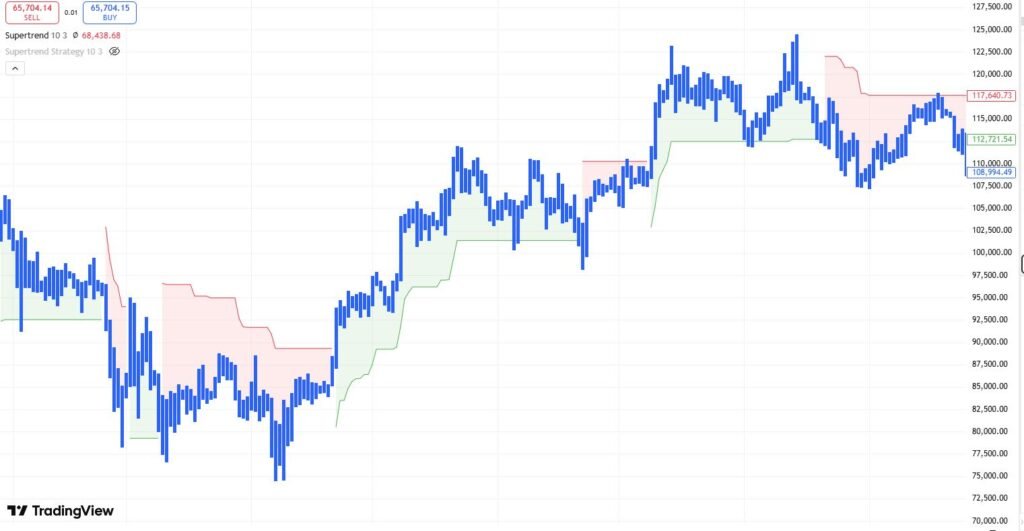
Why would you want that? Because in live trading, the Supertrend line can repaint slightly on the current candle — it shifts position as new price data comes in before the candle closes. This can cause you to see a signal that disappears by the time the candle actually closes.
A small positive offset smooths this out. You’re trading confirmed signals from completed candles rather than potentially repainting signals from the current incomplete candle.
When you apply a negative offset — say, offset -2 — you’re projecting the Supertrend line slightly forward. This can give you a visual preview of where the indicator is likely to be in coming candles, which some traders use for planning entries.
Most traders use zero offset and never think about it. A subset of traders use a small positive offset — typically 1 or 2 — to reduce signal noise and avoid acting on unconfirmed signals. Very few use negative offset, and honestly it’s the least practically useful of the three.
Why This Actually Matters in Real Trading
Let me describe something that probably sounds familiar.
You’re watching a chart. The Supertrend line is red — downtrend. Price has been falling. You’re considering a short entry.
Then you see it. The current candle is trading above the Supertrend line. The indicator flips green on your screen right now, in real time. You enter long.
The candle closes. The Supertrend line is red again. The flip never confirmed. You’re now in a long trade with the indicator back in downtrend mode.
This is repainting. And with Supertrend at zero offset, it happens more than most traders realize — especially on volatile assets like Bitcoin or GBP/JPY where candles move aggressively before closing.
A positive offset of 1 or 2 means you’re always looking at confirmed, closed-candle signals. The line you see has already been calculated on completed data. What you see is what you get — no more phantom flips that disappear on the close.
This one adjustment reduced my false entry rate significantly. Not because I changed my strategy, but because I stopped entering on signals that hadn’t actually confirmed yet.
The ATR Setting vs The Offset Setting — Understanding the Relationship
A lot of traders confuse the offset with the multiplier, or think that adjusting the multiplier solves the same problem as adjusting the offset. They don’t do the same thing.
The multiplier controls how far from price the Supertrend line sits. Higher multiplier = line sits further away = fewer signals, less noise, wider stops. Lower multiplier = line sits closer to price = more signals, more noise, tighter stops.
The ATR period controls how many candles are used to calculate average volatility. Higher period = smoother line, slower to react. Lower period = more reactive line, more sensitive to recent price moves.
The offset controls the horizontal timing of when signals appear relative to price — it’s about delay, not distance.
You can think of it this way: multiplier and ATR affect the shape and position of the line. Offset affects the timing of when you act on it.
For most swing trading setups, I use ATR 10, multiplier 3, offset 1. For faster day trading setups, I sometimes use ATR 7, multiplier 2, offset 1. The offset stays at 1 almost always — it’s the one setting I’ve standardized because the benefit of confirmed signals applies regardless of other settings.
How I Tested This — The Backtesting Process
After that evening I discovered the offset setting, I wanted to actually quantify the difference rather than just assume it helped.
I went back through six months of EUR/USD data on the 4-hour chart in TradingView. I used the bar replay feature — which lets you scroll back in time and play price action forward candle by candle — to manually test Supertrend signals at three offset settings: 0, 1, and 2.
For each signal, I logged the entry price, stop loss (just beyond the Supertrend line), and whether the trade was a winner or loser if held to the next signal flip.
The results weren’t dramatically different — Supertrend is Supertrend regardless of offset — but they were meaningfully different in one specific way: at offset 0, I had 11 false signals in that six-month period where the indicator appeared to flip but the candle closed unchanged. At offset 1, I had 3. At offset 2, I had 1 — but I also missed 4 entries that would have been good trades because the confirmation came too late.
Offset 1 hit the sweet spot. Enough delay to eliminate most false signals. Not so much delay that it materially hurt my entry timing.
This won’t be the same for every asset or timeframe — that’s the point. You have to actually test it on what you trade. But the process of testing it taught me more about how the indicator behaves in real conditions than reading about it ever did.
How to Set Offset in TradingView — Step by Step
This is where most articles stop at theory. Let me actually show you how to do this.
Step 1: Add Supertrend to your chart In TradingView, click the Indicators button at the top of the chart. Search “Supertrend.” Add it. The default will appear — green/red line above and below price.
Step 2: Open the settings Click the settings gear icon next to “Supertrend” in your indicator list, or double-click the indicator line on the chart. The settings panel opens.
Step 3: Find the Offset field In the settings panel, you’ll see the standard inputs: ATR Length and Factor (multiplier). Below those, look for “Offset.” It’s typically in the style or inputs tab depending on the platform version. It defaults to 0.
Step 4: Change it to 1 Type 1 in the offset field. Click OK. Watch how the line shifts slightly to the right on your chart.
Step 5: Compare with your chart history Scroll back through recent price action. Look at where the Supertrend flipped previously. Do the signals look cleaner? Do the flips align better with confirmed candle closes rather than mid-candle moves?
Step 6: Save as a template Once you’ve settled on settings you’re happy with, save them as a template in TradingView. Right-click the indicator → Save as template. Name it something like “ST-4H” or “ST-Day” depending on the timeframe. This saves you from reconfiguring every time you open a new chart.
On MetaTrader — How Offset Works Differently
If you’re using MetaTrader 4 or 5, the Supertrend indicator isn’t built in — you need to download a custom version from the MT4/MT5 marketplace or from trading communities.
Different custom Supertrend versions handle offset differently. Some have it as a direct input. Some don’t have it at all — in which case you’d need to manually wait for candle close before acting on signals, which is the same effect as a small positive offset but requires discipline rather than automation.
My recommendation for MT4 users: find a Supertrend version that clearly shows signals only on confirmed closed candles. Check the comments section of any indicator you download — traders who use it will mention if it repaints or not. Repainting is the specific problem offset helps solve, so non-repainting Supertrend versions effectively build in the offset benefit without requiring manual adjustment.
The Pairs and Timeframes Where Offset Matters Most
Through my own testing and observation, offset adjustment makes the biggest difference in two specific contexts.
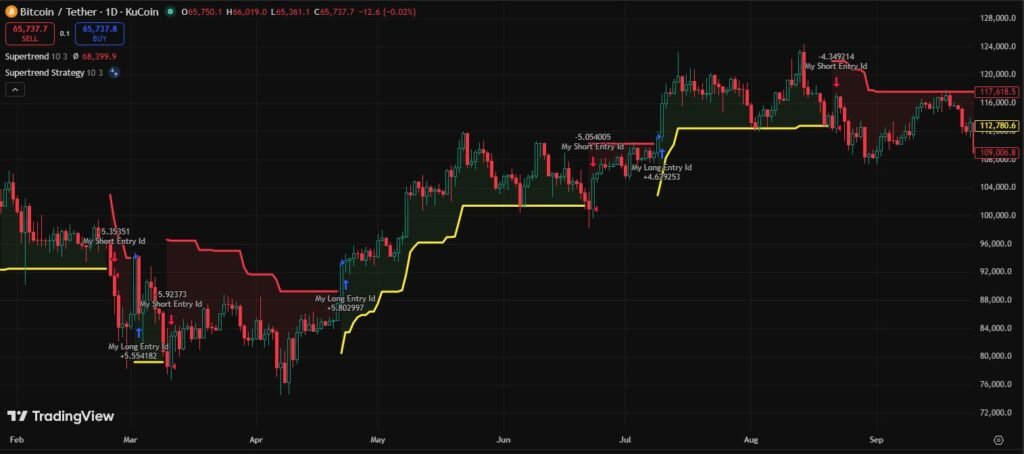
High-volatility assets: Bitcoin, Ethereum, GBP/JPY, XAU/USD (Gold). These assets move aggressively within candles, which creates more mid-candle Supertrend flips. The higher the intracandle volatility, the more repainting occurs at zero offset. Offset 1 or 2 is more valuable here.
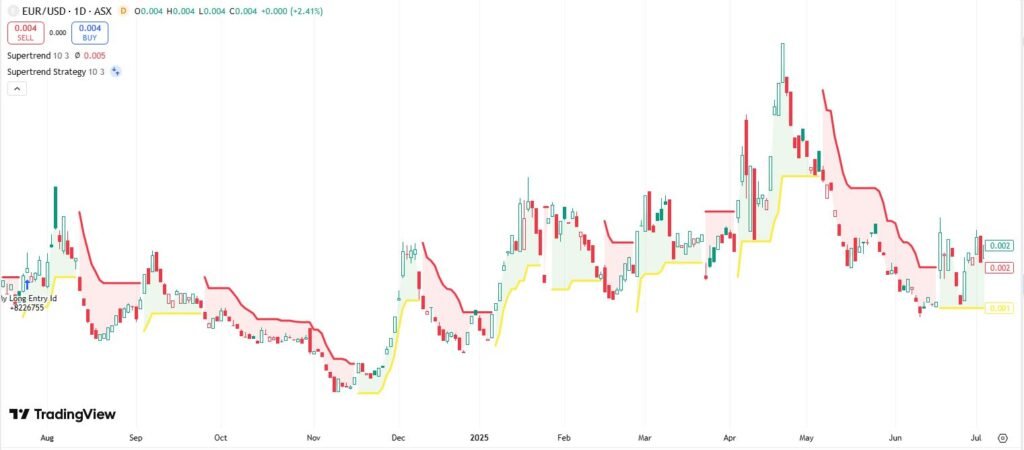
Lower timeframes: On a 5-minute or 15-minute chart, candles close frequently and volatility within candles can be significant relative to the ATR. False signals are more common. A small positive offset helps filter noise. On daily or weekly charts, repainting is much less of an issue — daily candles close once, and by the time you’re looking at them, the signal is already confirmed. Offset matters less here.
For what it’s worth: I use offset 1 on everything below the daily timeframe and offset 0 on daily and weekly charts. The daily closes once — by the time I’m analyzing it in my evening routine, it’s already confirmed. No need to delay it further.
Common Mistakes Traders Make With Offset
Setting offset too high. Offset 5 or 10 sounds like “more confirmation” but it just means you’re acting on signals that are significantly old. If the market moves fast, a high offset means you’re always arriving late to the trade. The signal was valid five candles ago — by now, price may have already moved 80% of the anticipated distance.
Changing offset without understanding why. I’ve seen traders in forums recommend offset 3 or offset -1 without explaining the reasoning. They found it worked on one backtest and extrapolated it as universally correct. Your offset should be chosen based on your specific asset, timeframe, and how much repainting you’re seeing in practice. Don’t copy someone else’s settings without understanding them.
Confusing offset with the multiplier. If your Supertrend is giving too many false signals, the instinct is often to increase the offset. But sometimes the real issue is that the multiplier is too low — the line is too close to price and flips with minor moves. Increase the multiplier before experimenting with offset. They solve different problems.
Using offset as a substitute for confirmation. Offset 1 or 2 reduces repainting. It does not eliminate the need for trade confirmation. Even with offset enabled, I still want to see a candle close beyond the Supertrend line, ideally with volume, before entering. Offset reduces noise — it doesn’t replace judgment.
Not testing on the asset you actually trade. What works for EUR/USD on the 4-hour chart may not be optimal for Bitcoin on the 1-hour chart. The whole point of offset optimization is that it should be tailored. If you’re going to adjust it, spend 30 minutes backtesting on your specific setup before going live.
Combining Supertrend Offset With Other Tools
Supertrend with a tuned offset is more useful as part of a system than as a standalone tool.
Here’s how I typically combine it:
With SMC (Smart Money Concepts): I use Supertrend on the 4-hour chart with offset 1 to confirm trend direction. Then I drop to the 1-hour chart to find order blocks and liquidity sweeps in the direction of the Supertrend signal. The Supertrend tells me which way to trade — SMC tells me where to enter.
With Volume: A Supertrend flip confirmed with above-average volume is significantly more reliable than a flip on quiet volume. I always check the volume bar when a signal appears. High volume flip = I pay attention. Low volume flip = I wait and watch.
With Support and Resistance: A Supertrend long signal that occurs right at a key support level — or a short signal at a key resistance — carries more weight than a signal in the middle of a range. The confluence of Supertrend direction and horizontal level gives me higher confidence in the entry.
With RSI: I use RSI as a filter, not a trigger. If Supertrend flips long but RSI is already above 70 and overextended, I skip the entry. The trend may be turning, but I’m arriving late. If Supertrend flips long and RSI is coming off oversold territory around 40-50, that’s a better setup — I’m entering at a reasonable point in the cycle.
What My Charts Actually Look Like Now
After all the experimentation, here’s the exact setup I use on TradingView for swing trading:
Chart type: Candlestick Timeframe: 4-hour primary, 1-hour for entry Supertrend settings: ATR 10, Multiplier 3, Offset 1 Volume: Standard volume bars, 20-period moving average overlay Nothing else
No MACD. No Bollinger Bands. No additional moving averages cluttering the view.
The cleaner the chart, the clearer the signals. Supertrend with a tuned offset, combined with price structure and volume, gives me everything I actually need to make trading decisions.
I spent years adding indicators and wondering why my results weren’t improving. The irony is that simplifying — and understanding the few tools I kept at a deeper level — is what actually changed things.
A Practical Example: EUR/USD 4-Hour Chart
Let me walk through a real-type scenario to make this concrete.
EUR/USD has been in a downtrend. Supertrend (ATR 10, multiplier 3, offset 1) is red and sitting above price.
Price makes a strong bullish move. On the current candle, you see the Supertrend line appearing to flip green in real time. Without offset, you might enter here.
With offset 1: you wait. The candle closes. Check the previous candle’s confirmed Supertrend value — is it green? Yes. Volume on the flip candle is above average. The signal is confirmed.
You enter long at the open of the next candle. Stop loss just below the Supertrend line. Target at the next significant resistance level.
This is the difference offset makes in practice — it introduces a disciplined pause between “the indicator appears to signal” and “the signal is confirmed.” That pause, small as it is, filters out a meaningful percentage of false entries.
The Bigger Picture
The offset setting in Supertrend is a small thing. It shifts a line by a candle or two. It’s not a strategy in itself, and it won’t transform losing trades into winning ones.
But trading is built on small edges. Reducing false signals by even 20-30% through better confirmation practices adds up over dozens of trades in a month. Small improvements in entry quality compound over time.
More importantly, understanding offset teaches you something about how indicators actually work — they’re calculations on historical data, and the way you choose to display and act on those calculations affects your results. Most traders treat indicators as black boxes. Opening the settings panel and actually thinking about what each input does is the beginning of using tools intelligently rather than just hopefully.
The offset field sat at zero on my charts for eight months. When I finally understood what it did and changed it to 1, my signals got cleaner. My entries got better. Not dramatically — just meaningfully.
In trading, meaningfully better is enough.
Frequently Asked Questions
What is offset in indicator?
Offset shifts an indicator line horizontally on your chart — positive offset delays the signal by set candles, helping you trade confirmed closed-candle signals instead of repainting real-time ones.
How to avoid false signals with supertrend?
Use offset 1 to wait for candle close confirmation, increase the multiplier to 3 or higher, and always combine Supertrend signals with volume confirmation before entering any trade.
What is the best setting for Supertrend?
ATR 10, Multiplier 3, Offset 1 works well for most markets. But always backtest on your specific asset and timeframe — no single setting is universally perfect for every market.
What is 25 75 percentile supertrend?
It’s an advanced Supertrend version that uses 25th and 75th percentile price ranges instead of ATR — creating dynamic bands that adapt more precisely to market structure and reduce noise in choppy conditions.
Disclaimer:
This article is for educational purposes only and does not constitute financial or investment advice. Trading involves significant risk of loss. Always conduct your own research and consider consulting a qualified financial advisor before making any trading decisions.

Hira Ch is a Forex trader and financial content writer specializing in gold, crypto, and currency markets.Based in Lahore, she breaks down complex trading
concepts into simple, actionable insights at ExpertJourny.