Trading Oil Futures Contract.The first time I heard the words “crude oil futures,” I was sitting in a tiny apartment in Lahore, watching a YouTube video at 2 AM about how traders made fortunes during the 2020 oil price crash. You probably remember that moment — April 2020, when oil prices went negative for the first time in history. Negative. People were being paid to take oil off someone’s hands.
I thought, okay, this market is insane. I want in.
So I opened a demo account on MetaTrader 5, pulled up WTI Crude Oil, and started clicking buttons like I owned the place. Within a week I was convinced I understood oil futures. Within two weeks of going live, I had lost $800 in three trades.
That was my real education.
This article is everything I wish someone had explained to me before I touched a single lot of crude. Not the textbook version — the actual version, with the mistakes, the weird moments, and the things that finally clicked.
What “Oil Futures Contract” Actually Means in Plain Language
Forget the formal definition for a second.
Here’s how I now explain it to people: imagine you walk up to an oil producer and say, “I’ll pay you $75 per barrel for 1,000 barrels of oil, delivered in December.” You both shake hands. That agreement — that locked-in price for a future delivery — is a futures contract.
Now here’s the twist: 99% of retail traders like you and me never actually want the oil. We’re not building a refinery. We’re just betting on whether the price goes up or down before the contract expires. Before delivery day comes, we close the trade.
That’s it. That’s the whole game at the retail level.
One standard WTI crude oil futures contract on the CME (Chicago Mercantile Exchange) controls 1,000 barrels of oil. At $80 per barrel, that’s $80,000 worth of oil in one contract. Obviously most retail traders — me included — don’t trade the full CME contract. We trade what’s called a CFD (Contract for Difference) on oil futures, which is basically a mirror of the price without the actual delivery mechanics. More on that below.
The Difference Between WTI and Brent — and Why It Matters
I used to think oil was just oil. Wrong.
There are two main benchmarks you’ll encounter constantly:
WTI (West Texas Intermediate) — This is US crude. It’s lighter, sweeter (lower sulfur), and traded on the CME in the US. The ticker is CL. When Americans talk about “the oil price,” they usually mean WTI.
Brent Crude — This is North Sea crude from Europe. It’s the global benchmark and is slightly more expensive than WTI in most market conditions. The ticker on ICE (Intercontinental Exchange) is CO or B.
For most of my trades, I use WTI because the spreads on my broker (IC Markets) are tighter and the liquidity is better during New York session. But if you’re following European news — Middle East tensions, OPEC decisions affecting global supply — Brent tends to react slightly faster.
Early on I made the mistake of watching a Brent price alert and then trading WTI expecting the same move. They’re correlated but not identical. The spread between them (called the Brent-WTI spread) changes constantly. Lesson learned.
How the Contracts Actually Work — Expiry, Rollover, and That Trap Nobody Warns You About
This is where most beginners get blindsided. I definitely did.
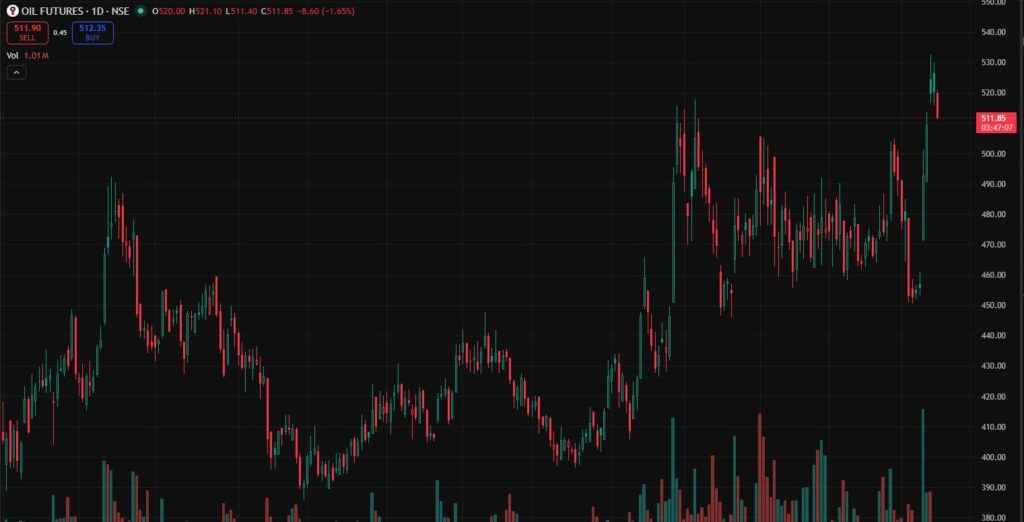
Oil futures contracts expire every month. The “front month” contract is the one closest to expiry, and it typically has the most liquidity and the tightest spreads. As expiry approaches, most traders “roll” their positions to the next month’s contract.
Here’s what caught me off guard: the rollover gap.
When I was holding an oil CFD position through my broker during a contract rollover period, I woke up one morning to see my position was down $120 for no apparent reason. The chart showed no big move. But my P&L was bleeding.
What happened was a “negative roll adjustment.” When the market rolls from the expiring contract to the next month, there’s sometimes a price gap between the two (called contango when the future price is higher than spot, or backwardation when it’s lower). My broker applied this difference as a cash adjustment to my account.
It’s not a scam. It’s how futures work. But my broker’s notification about this was buried in a PDF in their terms and conditions. Nobody told me at onboarding.
Practical tip: Check your broker’s rollover policy before holding oil positions overnight near contract expiry. On MetaTrader 5, you can see the contract specs including rollover dates under the instrument information panel. On cTrader, it’s under “Symbol Info.”
The Platforms I’ve Actually Used
I’ve traded oil on three platforms. Here’s my honest take:
MetaTrader 5 (MT5)
This is where I started. It’s clunky looking, but the charting is solid, the one-click trading works well, and there are thousands of free indicators. The mobile app is decent for checking positions but I wouldn’t use it to enter trades on oil — spreads can widen during mobile sessions and you might get a worse fill.
CTrader:
Cleaner interface, more transparent pricing. I could see the actual depth of market (DOM) on oil which helped me understand where liquidity was sitting. Better for scalping. If you’re new, cTrader feels more modern and less overwhelming than MT5.
TradingView (for analysis only):
I do all my oil chart analysis on TradingView before placing trades on MT5. TradingView’s oil charts are cleaner, the drawing tools are better, and I can set alerts when price hits a certain level. Then I switch to MT5 to execute. This two-platform workflow took me a while to set up but it’s made me much more disciplined.
I’ve heard good things about Thinkorswim (TD Ameritrade’s platform) for actual CME futures trading if you’re US-based and want to trade the real contract — not CFDs. But for the rest of us, CFDs on a regulated broker is the realistic path.
What Actually Moves Oil Prices — The Things I Track Every Week
When I first started, I thought oil moved because of “supply and demand.” True, but uselessly vague. Here’s what actually moves the needle in the short to medium term:
1. The EIA Weekly Inventory Report
Every Wednesday at 10:30 AM Eastern Time (that’s 8:30 PM Pakistan time for me — late night coffee required), the US Energy Information Administration releases its weekly crude oil inventory numbers. This is the single most market-moving regular event in oil trading.
If inventories are higher than expected = more supply = price tends to drop. If inventories are lower than expected = tighter supply = price tends to rise.
I learned to get out of positions before this release or at least tighten my stop-loss significantly. The spread on oil can jump from $0.03 to $0.15 in the seconds before and after the report. I’ve been stopped out by the spread alone during high-volatility releases.
2. OPEC+ Production Decisions
OPEC+ (that’s OPEC plus Russia and other allies) meets periodically to decide output targets. If they announce production cuts, oil prices spike. If they increase production or fall out with each other (which happens more than you’d think), prices drop.
I follow the OPEC news calendar on the Investing.com app. Worth having on your phone.
3. US Dollar Strength
Oil is priced in USD globally. When the dollar strengthens, oil becomes more expensive for buyers using other currencies, which can reduce demand and push prices down. When the dollar weakens, oil tends to rise.
This is why I always have the DXY (Dollar Index) chart open alongside my oil chart. On TradingView I use a split screen — oil on the left, DXY on the right. When they’re moving in opposite directions at the same level, it confirms the move.
4. Geopolitical Events
Any conflict in the Middle East, sanctions on major oil-producing nations, or shipping disruptions in the Strait of Hormuz (about 21% of global oil passes through it) can spike prices within minutes. This is harder to predict but easy to react to with alerts.
I use the Telegram channel from the Reuters commodities desk and the Bloomberg Markets app for fast news. When I see a geopolitical headline, I immediately check my open oil positions before even reading the full article.
My Actual Trading Setup for Oil
I trade oil on the 4-hour chart primarily, with the daily chart for trend direction and the 1-hour chart for entry timing. Here’s my basic process — not a holy grail, just what’s worked for me more often than not.
Check the daily chart first.
Is oil in an uptrend, downtrend, or ranging? I use the 50 EMA and 200 EMA for this. If price is above both EMAs, I’m looking for long setups only. Below both, short setups only. Between them — I usually stay out unless there’s a very clear structure.
Identify key levels on the 4-hour chart.
Oil respects round numbers ($80, $85, $90) surprisingly well. It also respects previous highs and lows heavily. I draw these manually — I stopped using automated support/resistance indicators because they clutter the chart.
Wait for a clear signal on the 1-hour chart.
I like a combination of a pin bar or engulfing candle at a key level, plus RSI divergence if it’s there. If price hits $80.00 (a round number AND a previous support) and I see a bullish pin bar with RSI showing divergence on the 1-hour — that’s my setup.
Position sizing with oil specifically.
This is critical because oil moves fast and the pip value is different from Forex. On a standard lot of WTI CFD, each $1 move in oil = $1,000 profit or loss. That’s enormous. I never risk more than 1.5% of my account on any oil trade, and I calculate my lot size based on my stop-loss distance, not just a fixed lot.
If my account is $5,000 and I’m willing to risk 1.5% ($75), and my stop-loss is $1.50 away from entry, then: $75 ÷ $1.50 = 0.05 lots. Simple math, but I spent months ignoring it.
Mistakes I Made (So You Don’t Have To)
Trading oil during the Asian session.
Oil’s main liquidity hours are New York session (overlapping with London close) and right around the EIA report on Wednesdays. During the Asian session, oil spreads widen, price can chop around aimlessly, and you’re more likely to get stop hunted on low volume. I wasted three months wondering why my setups kept failing before I realized it was a timing issue, not a strategy issue.
Ignoring the correlation with natural gas.
Oil and natural gas are both energy commodities and often move together — but not always. There was a period in 2022 when natural gas was going parabolic while oil was cooling. I was so focused on oil that I missed the NatGas trade entirely. Now I at least glance at natural gas charts when I’m doing energy analysis.
Holding through the EIA report.
I did this twice. Both times I got destroyed by the spread and the volatility even when the price moved in my favor — because it reversed immediately after. Now I either close before the report or accept that I’m “letting it ride” as a deliberate choice with a wider stop.
Using too much leverage early on.
Most retail brokers offer 1:100 or even 1:500 leverage on oil. I used 1:100 in my early days. A $0.50 move against me would wipe 5% of my account in seconds. Now I use 1:10 for oil and I sleep much better.
Not understanding contango vs backwardation.
I mentioned this earlier, but the contract structure of oil matters. During the COVID crash when oil went negative, it was because the May 2020 contract was expiring and there was physically nowhere to store oil — so the front month went to -$37. Traders who held long positions in that specific contract lost everything and then some. Understanding that futures contracts have delivery mechanics — even if you never take delivery — would have made this less of a shock.
Practical Questions I Get Asked A Lot
“Can I trade oil with a small account — like $500?”
Honestly, yes, but carefully. With $500 and 1% risk per trade, you’re risking $5 per trade. You can trade micro lots on most CFD brokers (0.01 lots). But oil is volatile enough that a bad month can cut your account in half if you’re not disciplined. I’d suggest paper trading for at least 30-60 days first, tracking every trade in a journal (I use a simple Google Sheet with date, entry, exit, reason, and lesson).
“What broker should I use?”
I use IC Markets. Spreads on WTI are usually around 0.03 to 0.05 during liquid hours, which is tight. Pepperstone is also well-regarded. For Pakistan-based traders, make sure the broker accepts your country and that withdrawals to a local bank or Wise work smoothly — ask support before depositing. Avoid brokers that aren’t regulated by FCA, ASIC, or CySEC at minimum.
“Is trading oil halal?”
This comes up a lot in Pakistan and the Gulf. Most scholars consider conventional futures trading with interest-bearing swaps to be impermissible. Some brokers offer Islamic (swap-free) accounts. IC Markets has one. The fiqh of CFDs is still debated, so I’d recommend consulting a scholar you trust rather than taking my word for it.
The One Thing That Changed My Oil Trading More Than Anything Else
It wasn’t a new indicator. It wasn’t a new strategy.
It was keeping a trading journal and reviewing it every Sunday.
Every week I sit down with my journal (it’s literally a Google Sheet) and answer three questions about each closed trade:
- Did I follow my plan?
- What did the market teach me this week?
- What am I going to do differently?
About six months in, I noticed a clear pattern: I consistently made money on Wednesday oil trades that set up before the EIA report and gave a clear direction after it — if I waited for the initial spike and reversal and then entered in the direction of the second move. That specific insight came entirely from reviewing my journal. No YouTube video would have shown me that because nobody else’s trades would show it — it was specific to how I was already reading the market.
Your journal will show you your edge. Not a borrowed edge from someone else’s strategy.
A Few Things Worth Knowing Before You Start
The oil market is one of the most liquid markets in the world — second only to major Forex pairs and US equity futures. That’s good for retail traders because the spread is tight and price discovery is genuine. There aren’t many thin-market traps.
But it’s also one of the most news-sensitive markets. A single tweet from a Saudi oil minister or an unexpected API inventory number (released Tuesday evenings — the private sector preview before the Wednesday government report) can move price $2 in minutes.
You don’t have to predict these events. You just have to have a plan for when they happen. My plan is simple: if I’m in a trade and news is about to drop that I didn’t plan for, I close half and move my stop to breakeven. I’d rather miss some profit than blow my account on a news spike.
The market will always be there tomorrow. Your account might not be if you don’t protect it.
Where to Keep Learning
A few resources I actually use:
- EIA.gov — free weekly oil inventory data, historical charts, demand forecasts. Genuinely useful and completely free.
- Investing.com — commodity calendar, live oil quotes, forum for sentiment reading (take the sentiment with a grain of salt).
- TradingView — the best free charting tool for oil. Use the “Supertrend” and “Volume Profile” indicators on oil — both reveal a lot about momentum and key price levels.
- CME Group website — if you want to understand the real futures contract specs, delivery dates, and margin requirements. Worth reading even if you’re trading CFDs.
Final Thought
Oil trading is genuinely exciting. There’s nothing quite like watching a trade play out during an EIA release — the candles flying, the spread jumping, then price finding direction and running.
But excitement is also the danger. I’ve made my best trades when I was calm, had a plan, and was almost bored waiting for my setup. The worst trades I’ve ever made were impulsive, emotionally charged, and usually entered because I felt like I was “missing out.”
If you’re just starting out with oil futures — start on demo. Not for a week, but for a genuine 60-90 days. Trade it like it’s real money. Then go live small. Learn how the market feels during news events, how rollover affects your positions, how liquidity thins out in the Asian session.
The market isn’t going anywhere. Take your time to understand it before it takes your money.
Disclaimer: This article is for educational purposes only and reflects personal experience and observations. It is not financial advice. Trading oil futures and CFDs carries significant risk of loss. Always do your own research and consider speaking with a qualified financial advisor before trading.
Frequently Asked Questions:
Q1: How do oil futures contracts work?
You agree to buy or sell a set amount of oil at a fixed price on a future date. Most retail traders never take delivery — they close the trade before expiry to pocket the price difference.
Q2: Is trading oil futures profitable?
It can be, but most beginners lose money first. Profitability comes from strict risk management, timing around key events like the EIA report, and months of consistent practice.
Q3: Can I trade crude oil futures?
Yes — retail traders can trade crude oil through CFD brokers like IC Markets or Pepperstone without needing a CME account or taking physical delivery of oil.
Q4: How to buy an oil futures contract?
Open an account with a regulated CFD broker, search for WTI Crude Oil or CL, choose your lot size based on your risk, and place a buy order — it takes under two minutes.

Hira Ch is a Forex trader and financial content writer specializing in gold, crypto, and currency markets.Based in Lahore, she breaks down complex trading
concepts into simple, actionable insights at ExpertJourny.




One Comment