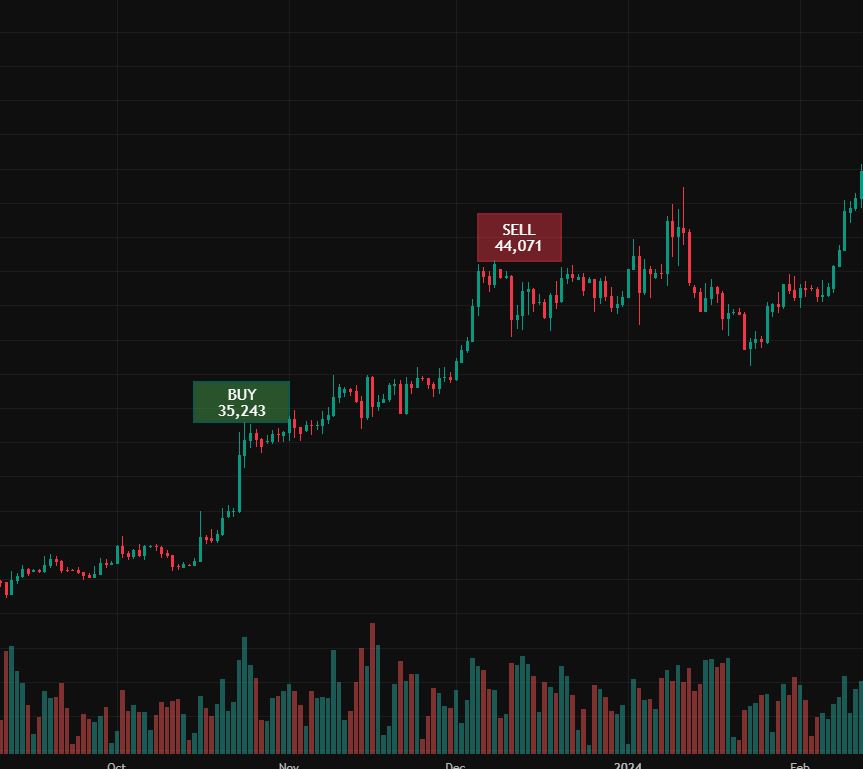
What is Spot Trading in Crypto.My first crypto trade was a disaster. Not because I lost money — I actually made a small profit. It was a disaster because I had absolutely no idea what I was doing or what type of trade I had just made.
I had opened a position on a platform I’d signed up for the night before. Bought some Bitcoin. Watched it go up 4%. Sold it. Felt like a genius.
Then a friend asked me: “Was that spot or futures?”
I stared at him. “What’s the difference?”
He explained it. And the more he talked, the more I realized I’d gotten lucky — not smart. Because if I had accidentally opened a leveraged futures position instead of a simple spot trade, that same 4% move could have meant very different things depending on my leverage. I could have been liquidated on a small dip before the price even reached my target.
I hadn’t known what I was trading. I just clicked buttons and hoped.
That conversation pushed me to actually understand spot trading — what it is, how it works, when to use it, and why for most people starting out in crypto, it’s genuinely the right place to begin.
What Spot Trading Actually Is — No Jargon
Spot trading is the simplest form of trading in any market, crypto included.
When you buy crypto on spot, you actually own it. The coins go into your account. They’re yours. If you buy 0.1 Bitcoin on spot, you have 0.1 Bitcoin sitting in your wallet or exchange account. You can hold it for a day, a year, or a decade.
When you sell spot, you’re selling the actual coins you own and receiving cash (or stablecoins) in return.
That’s it. No leverage. No borrowing. No contracts. No expiry dates. You buy a thing, you own the thing, you sell the thing when you want.
The word “spot” comes from the idea of settlement happening “on the spot” — immediately, at the current market price. You pay today’s price and receive the asset today.
This is fundamentally different from futures trading, where you’re entering a contract to buy or sell at a future date, often with leverage — meaning you’re controlling a position larger than your actual capital.
Spot is simple. Futures is complex. For most people learning crypto trading, spot is the right starting point.
Why Spot Trading Made More Sense to Me Than Futures (At First)
When I understood the difference, the appeal of spot trading became obvious.
With spot, the worst thing that can happen is the price goes to zero. You lose what you put in. That’s bad, but it’s finite. You know your maximum loss before you enter.
With futures and leverage, you can lose more than you put in — or get liquidated (your entire position wiped out) on a move that would have been completely survivable in spot.
I’ve seen traders lose their entire account on a 5% price move because they were 20x leveraged. The same 5% move on a spot position is annoying but survivable.
For someone learning to trade crypto — learning to read charts, manage emotions, understand market structure — adding leverage on top of all that is genuinely dangerous. Spot trading lets you focus on the trading itself without the constant liquidation risk sitting in the background.
This doesn’t mean futures is bad. Experienced traders use it effectively. But there’s a reason most people who blow up crypto accounts are trading futures, not spot.
How Spot Trading Works on Real Platforms
Let me walk through what spot trading actually looks like in practice, using platforms I’ve personally used.
Binance
Binance is the largest crypto exchange by volume and the one I started with. The spot trading interface is straightforward. You choose a trading pair — BTC/USDT means you’re buying Bitcoin with Tether (a stablecoin pegged to the dollar). You enter the amount, choose market order (buy at current price) or limit order (buy at a specific price you set), and confirm.
The coins appear in your spot wallet immediately. You own them. No contract, no expiry, no liquidation risk.
Binance charges a 0.1% fee on spot trades — or 0.075% if you hold their BNB token and use it to pay fees. For a $1,000 trade, that’s $1. Reasonable.
Coinbase
More beginner-friendly interface than Binance. Slightly higher fees. If you’re completely new to crypto and want the simplest possible experience, Coinbase works well. The spot trading is clean and easy to understand.
OKX
I moved to OKX after a while because their spot trading fees are competitive and their charting tools are built in. Good option if you want to do more technical analysis without switching between the exchange and TradingView.
Kraken
Well-regarded for security. Good option if you’re trading larger amounts and want a platform with a strong reputation for keeping funds safe.
For charting and analysis alongside any of these, I use TradingView. You can connect TradingView to most exchanges for execution or just use it for analysis while placing trades directly on the exchange.
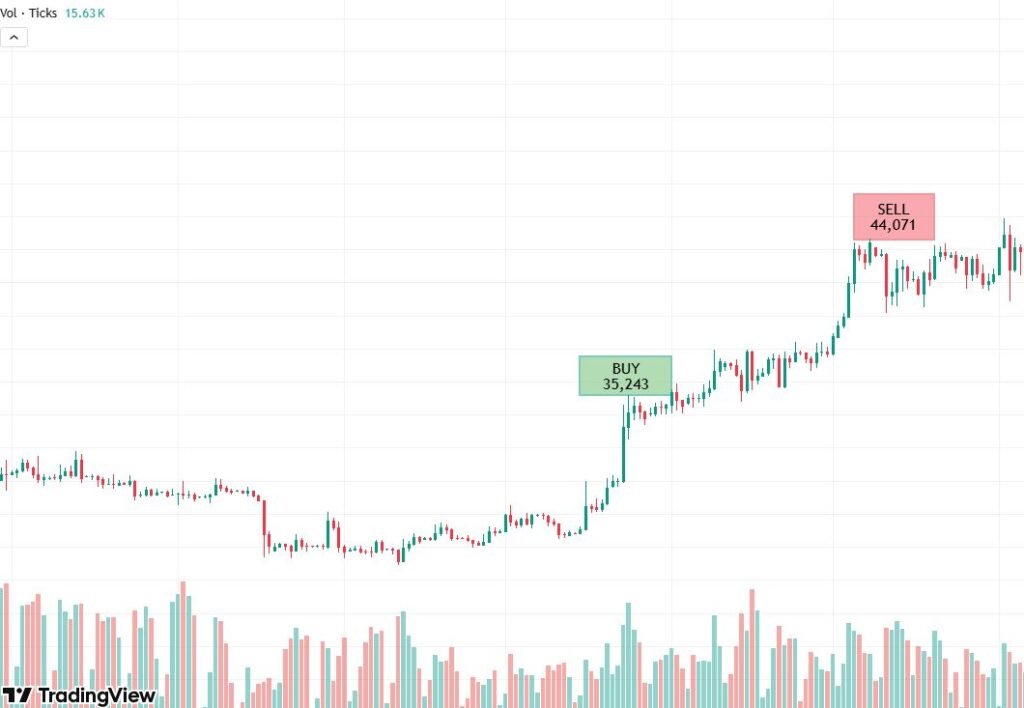
The Different Types of Orders in Spot Trading
Understanding order types is important — even in simple spot trading, using the right order type makes a real difference.
Market Order
You buy or sell immediately at whatever the current price is. Fast. Simple. But in volatile markets or for less liquid coins, you might get a slightly worse price than you expected — this is called slippage.
I use market orders when I need to enter or exit quickly — usually when a setup is playing out faster than expected and a limit order might not fill.
Limit Order
You set the exact price you want to buy or sell at. The order sits in the order book until price reaches your level — then it fills automatically.
This is my default for entries. If I’ve identified a key level I want to buy at — say the 61.8% Fibonacci retracement or a daily order block — I set a limit order there and walk away. Either price comes to me or it doesn’t.
Limit orders also typically have lower fees than market orders on most exchanges.
Stop-Limit Order
A two-part order. You set a trigger price and a limit price. When price hits the trigger, a limit order is placed at your specified price.
Useful for setting stop losses on spot positions — though unlike in futures trading, a stop on a spot position just means selling your coins if price drops to that level, not a forced liquidation.
Spot Trading vs Futures — The Honest Comparison
I want to be clear about this because a lot of content online either oversells futures or dismisses it entirely.
Spot Trading:
- You own the actual asset
- No liquidation risk
- No leverage (unless you use margin — but that’s a separate topic)
- Lower potential gains but also lower potential losses
- Simpler to understand and manage
- Better for long-term holding strategies
Futures Trading:
- You trade a contract, not the asset itself
- Liquidation risk if price moves against your leveraged position
- Amplified gains AND losses
- Requires much stronger risk management
- Better for experienced traders with clear strategies
My honest take: if you’ve been trading for less than a year, stick to spot. Get your chart reading right. Get your entry and exit logic right. Get your emotions under control. Then consider futures when you genuinely understand what you’re doing.
The number of people I’ve seen rush into leverage because “you can make more money faster” — and then blow their account within weeks — is genuinely sobering.
What Coins to Trade on Spot (And What to Avoid)
Not all crypto is equal for spot trading. Some practical guidance from experience:
Stick to high liquidity coins when starting.
Bitcoin (BTC) and Ethereum (ETH) are the most liquid crypto assets. High liquidity means tight spreads, fast execution, and lower slippage. When you’re learning, trade pairs like BTC/USDT or ETH/USDT.
Be careful with small cap altcoins.
Lower liquidity means wider spreads and higher manipulation risk. A coin with a $50 million market cap can be moved dramatically by a single large player. I’ve been in altcoin spot trades where the spread alone was 2-3% — meaning I was already down before the trade even had a chance to work.
Avoid new listings for spot trading.
New coins listed on exchanges often see massive price swings in the first hours and days. Some go up 500%. Many go down 80%. Trading new listings on spot is closer to gambling than trading. Until a coin has established price history and volume patterns, there’s nothing meaningful to analyze.
Stablecoins are your friend for holding cash.
When you sell a spot position and want to stay in the crypto ecosystem without being exposed to price movement, move into USDT or USDC — stablecoins pegged to the dollar. Much better than leaving funds in a volatile coin while you wait for the next setup.
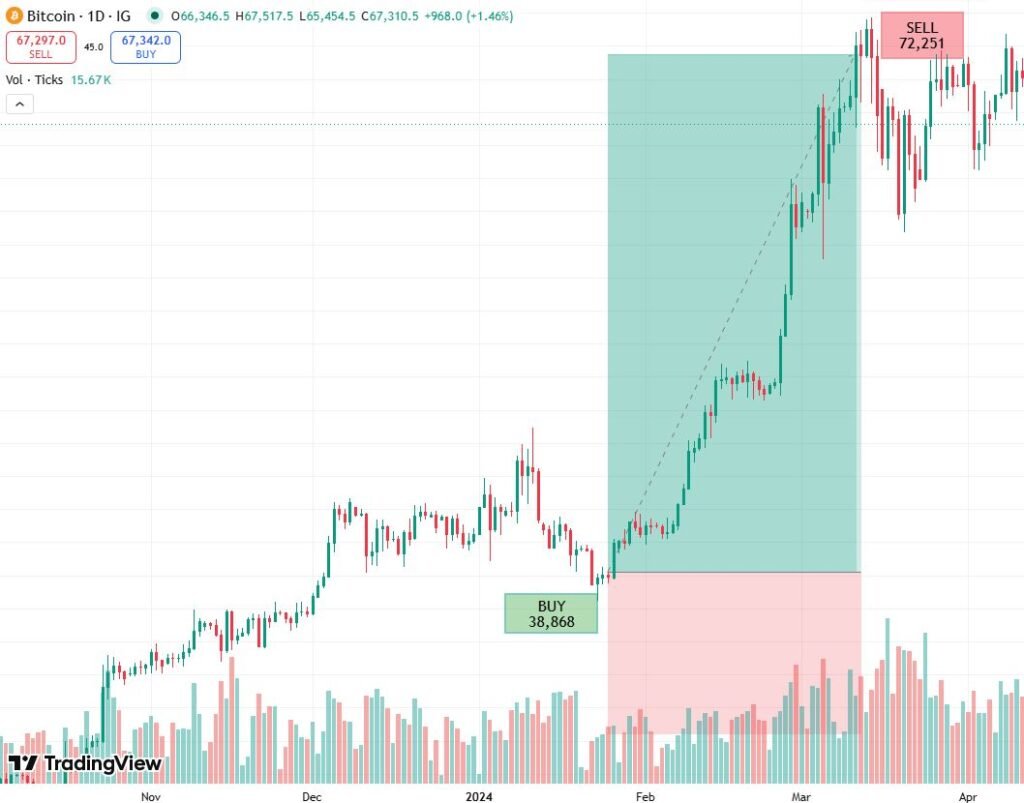
My Step-by-Step Process for a Spot Trade
Let me show you exactly how I approach a spot trade from start to finish.
Step 1: Identify the setup on TradingView.
I analyze the chart on TradingView — not on the exchange. Exchanges have basic charts but TradingView gives me proper tools. I look at daily and 4-hour timeframes. I’m looking for a clear trend, a key level (order block, Fibonacci level, previous support), and a reason to enter.
Step 2: Calculate my position size.
Even in spot trading, position sizing matters. I decide in advance what percentage of my trading capital I’m putting into this trade. Usually 5-10% for a single spot position — I’m not leveraged so I can afford slightly larger allocations than in futures, but I still don’t go all-in on one trade.
Step 3: Set a limit order at my entry level.
I go to the exchange (Binance in most cases), select the spot trading pair, and set a limit order at my identified entry price. I set it and walk away. If it fills, great. If price doesn’t reach my level, I wait for the next setup.
Step 4: Decide my exit levels in advance.
Where am I taking profit? Where am I cutting the loss if the trade goes wrong? In spot, there’s no forced liquidation — but that doesn’t mean you should hold forever hoping a bad trade recovers. Decide your exit before you enter.
Step 5: Set price alerts on TradingView.
I set alerts at my take profit and stop loss levels. When price reaches them, I get notified. Then I manually execute the exit. This keeps me from staring at the chart all day.
Step 6: Log the trade.
Every trade goes into my Google Sheets journal. Date, pair, entry, exit, outcome, notes. Non-negotiable habit.
Mistakes I Made in Spot Trading
Buying tops out of FOMO.
A coin goes up 30% in a day. Everyone’s talking about it. I buy near the high. It immediately drops 25% and stays there for weeks. I’ve done this multiple times. FOMO buying is the single most expensive habit in crypto spot trading.
Not having an exit plan.
I’d buy Bitcoin at a good level, it would go up 15%, and I’d think “I’ll wait for more.” Then it’d give back half the gains and I’d exit frustrated, having made 7% instead of 15%. Having a target in advance — even a partial one — fixes this.
Holding altcoins through a market-wide correction.
I once held a basket of altcoin spot positions when Bitcoin started dropping. Altcoins drop faster and harder than Bitcoin in corrections. What was a 15% portfolio gain became a 30% loss in three weeks because I didn’t have a plan for what to do when market conditions changed.
Moving funds to a new wallet without testing first.
This isn’t a trading mistake exactly but it matters: the first time you send crypto to an external wallet, always send a tiny test amount first. I know someone who sent $4,000 of ETH to a wrong address. Gone permanently. Test first. Always.
Chasing coins someone else recommended.
Telegram groups, Twitter influencers, “insider tips” — every single time I’ve bought a coin based on someone else’s recommendation without doing my own analysis, I’ve regretted it. By the time the recommendation reaches you, the people who recommended it are often already positioned and waiting to sell into your buying.
Tools That Make Spot Trading Easier
TradingView — analysis and alerts. Free version is sufficient for most spot traders.
Binance — spot execution, competitive fees, huge liquidity across hundreds of pairs.
CoinMarketCap or CoinGecko — for checking market cap, volume, and basic coin information before trading an unfamiliar asset.
Forex Factory — even for crypto, macro events matter. Fed decisions, inflation data — these move crypto markets significantly. Worth checking weekly.
Google Sheets — trade journal. Simple, free, effective.
The Reality of Spot Trading Returns
I want to be honest here because a lot of crypto content is unrealistic.
Spot trading crypto is not a path to getting rich quickly. In a bull market, holding quality assets on spot and trading them at good levels can produce solid returns. In a bear market, even good spot traders struggle because everything goes down.
Realistic expectations for a disciplined spot trader in reasonable market conditions: 20-50% annual returns is genuinely good. Anyone promising more than that consistently is either extremely lucky or not being honest.
The advantage of spot over futures isn’t return size. It’s survivability. You can hold through a correction without being liquidated. You can be wrong on timing and still be right on direction eventually. That durability is worth more than most traders realize until they’ve blown a leveraged account and learned the hard way.
Spot Trading Is Where Good Habits Are Built
Here’s the thing I genuinely believe after years of trading both spot and futures:
The habits you build in spot trading — patience, discipline, proper position sizing, having an exit plan, keeping a journal — are the exact same habits that make futures trading survivable when you eventually move there.
Traders who rush to futures without proper foundations don’t just lose money. They lose the opportunity to build the mental and technical skills that would eventually make them profitable.
Spot trading is not the “boring” version of crypto trading. It’s the version where you learn what actually matters — without a liquidation engine sitting underneath every trade waiting for you to make a mistake.
Start there. Get good there. Then decide if you need anything more complex.
Conclusion:
I think back to that first trade sometimes. The one where I didn’t even know if I was in spot or futures. Where I made 4% by pure luck and called myself smart.
That ignorance could have cost me everything on a different day.
Spot trading didn’t just teach me how crypto markets work. It taught me something more important — that understanding what you’re doing before you do it is the actual edge. Not the platform. Not the coin. Not the timing.
The understanding.
Every experienced trader I respect started with spot. Not because it’s the most exciting option. Because it’s the one that lets you make mistakes without those mistakes being permanent.
You’ll get entries wrong in spot. You’ll buy too early, sell too late, hold too long, exit too soon. All of that is normal. All of that is part of learning. And in spot, those mistakes cost you some percentage of a position — not your entire account in a single liquidation.
Frequently Asked Questions
How does crypto spot trading work?
You buy actual cryptocurrency at the current market price, own it immediately, and sell whenever you choose. No leverage, no contracts, no expiry — just real ownership.
What is an example of spot trading?
You buy 0.1 Bitcoin at $60,000 on Binance today. Price rises to $65,000 next week. You sell and pocket the difference. That’s spot trading — simple buy, own, sell.
Is spot trading in crypto safe?
It’s the safest form of crypto trading. You can only lose what you invest — no liquidation risk. Compared to futures, spot is significantly lower risk for everyday traders.
Is spot trading good for beginners?
Absolutely yes. No leverage, no liquidation, no complex contracts. Spot trading is where every serious crypto trader should start before touching anything more complex
Disclaimer:
This article is for educational purposes only and does not constitute financial or investment advice. Cryptocurrency trading involves significant risk of loss. Always conduct your own research and consider consulting a qualified financial advisor before making any investment decisions.

Hira Ch is a Forex trader and financial content writer specializing in gold, crypto, and currency markets.Based in Lahore, she breaks down complex trading
concepts into simple, actionable insights at ExpertJourny.