

Why Moving Averages Matter in Trading
moving average trading strategy for beginners. Prices move fast, charts look confusing, and emotional decisions usually lead to losses. What most new traders need is clarity, not complexity. This is exactly where the Moving Average Trading Strategy becomes powerful.
Moving averages are one of the oldest and most trusted tools in technical analysis. They help traders cut through market noise and focus on the true price direction. At ExpertJourny, we believe that mastering simple, proven concepts like moving averages is the first step toward long-term trading success.
This guide is designed especially for beginners. You will learn what moving averages are, how they work, different types, and how to use them in real trading situations across Forex, Crypto, and Stocks.
What Is a Moving Average Trading Strategy?
A moving average trading strategy is a technical approach that uses the average price of an asset over a specific period to identify trends. Instead of reacting to every price fluctuation, traders rely on moving averages to understand whether the market is:
Trending upward
Trending downward
Moving sideways
The main goal of a moving average is trend clarity. By smoothing price data, it helps traders avoid emotional decisions and trade in the direction of the overall market flow.
Think of a moving average as a trend filter. It removes unnecessary noise and highlights what really matters — direction.
How a Moving Average Actually Works
A moving average calculates the average price of an asset over a chosen number of periods (such as 20, 50, or 200). Every time a new price appears, the oldest data point is removed, and the average updates. That’s why it’s called “moving.”
In simple terms:
the moving average is rising → the trend is bullish
If the moving average is falling → the trend is bearish
If it’s flat → the market is ranging
This makes moving averages extremely useful for beginners who struggle to read raw price action.
Why Beginners Should Use Moving Averages
Moving averages are beginner-friendly because they are:
Easy to understand
Simple to apply on any chart
Effective in all markets
Excellent for trend confirmation
Unlike complicated indicators, moving averages focus on one core principle: price direction. This simplicity allows new traders to build confidence and discipline early in their trading journey.
1. Simple Moving Average (SMA)
The Simple Moving Average (SMA) is one of the most popular tools used by traders to understand market trends. It calculates the average price of an asset over a specific number of periods, whether that’s days, hours, or minutes. By smoothing out price fluctuations, SMA helps traders identify the overall direction of the market, whether it’s trending up, down, or moving sideways. Traders often use SMA to spot potential support and resistance levels, confirm trends, and generate trading signals. For example, when the price crosses above the SMA, it might indicate a buying opportunity, while crossing below could suggest a potential sell. While simple in calculation, SMA is highly effective when combined with other indicators and trading strategies.
Best for
Long-term trend analysis
Beginners learning market structure
Limitation
It reacts slowly to sudden price changes, which can delay entry signals.
2. Exponential Moving Average (EMA)
The Exponential Moving Average gives more importance to recent prices, making it more responsive than the SMA.
Best for:
Short-term and intraday trading
Early trend detection
Risk:
Because it reacts faster, it may generate false signals in choppy markets.
3. Weighted Moving Average (WMA)
The Weighted Moving Average also emphasizes recent prices but uses a different calculation method.
Best for:
Traders who want balanced sensitivity
Faster response than SMA with smoother behavior than EMA
Most trading platforms calculate this automatically, so manual calculation is not required.
Choosing the Right Moving Average Timeframe
Timeframe selection is critical for strategy performance.
Common combinations:
Short-term traders: 5, 10, 20
Swing traders: 20, 50
Long-term traders: 100, 200
Shorter periods provide faster signals but more noise. Longer periods are smoother but slower.
Beginners should start with the 20 and 50 moving averages for balanced results.
How Moving Averages Help Identify Trends
Moving averages act like a trend compass:
Price above the moving average → Uptrend
Price below the moving average → Downtrend
Flat moving average → Sideways market
The angle of the moving average also matters. A steep slope indicates strong momentum, while a flat slope signals weak market conditions.
Moving Averages as Dynamic Support and Resistance
Moving averages often act as dynamic support and resistance levels.
In an uptrend, price frequently bounces from the moving average
In a downtrend, price struggles to break above it
Traders use this behavior to:
Plan entries
Set stop-loss levels
Identify exit zones
This makes moving averages useful not just for entries, but also for risk control.
Moving Average Crossover Strategy
This strategy uses two moving averages:
One fast (short period)
One slow (long period)
Bullish signal:
When the fast moving average crosses above the slow one.
Bearish signal:
When the fast moving average crosses below the slow one.
This strategy works best in strong trending markets and should be avoided during sideways conditions.
Moving Average Envelope Strategy
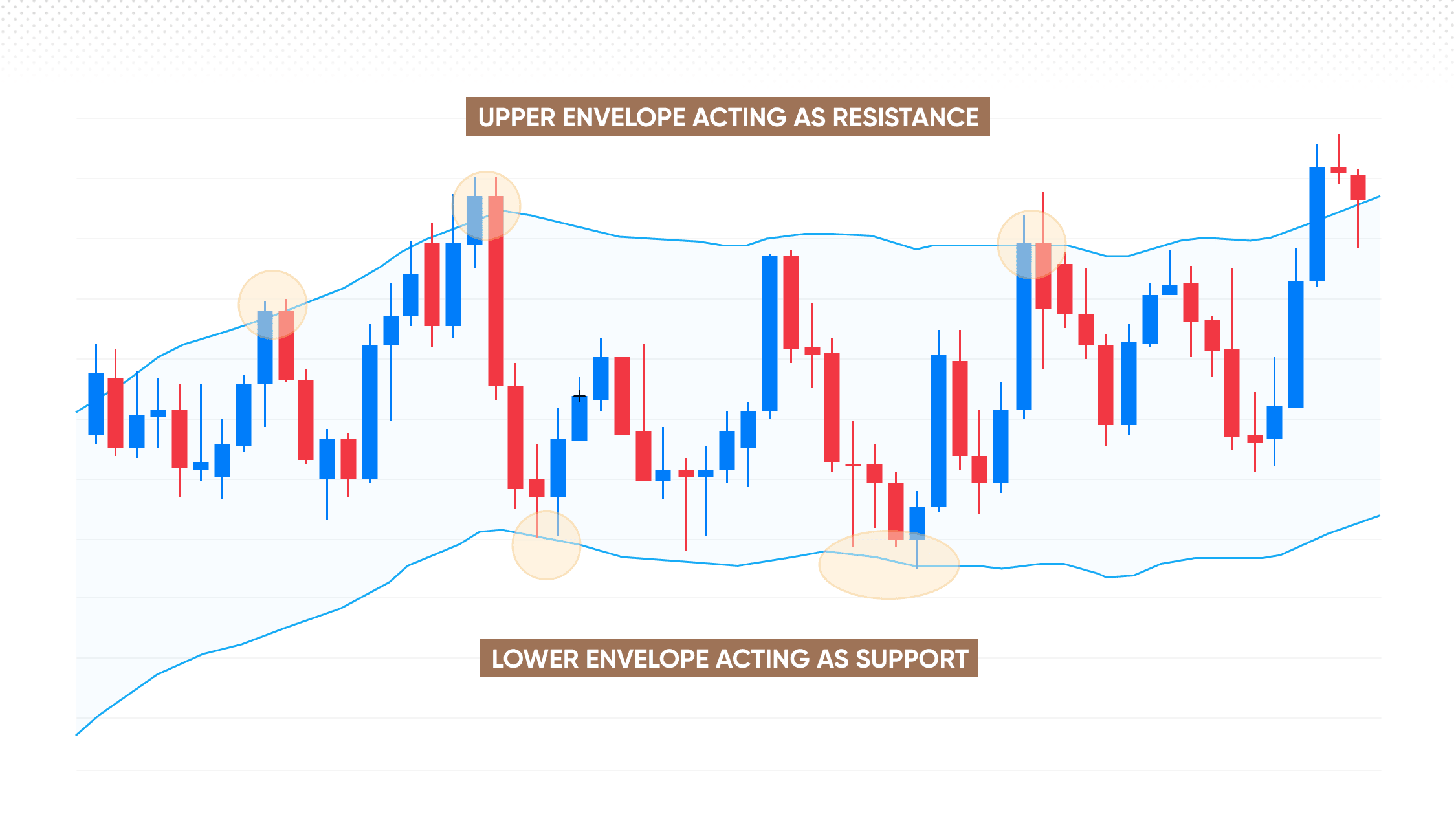
This strategy places two bands above and below a central moving average.
Upper band → Potential overbought area
Lower band → Potential oversold area
Traders use envelopes to identify pullbacks and possible reversals near extreme levels.
Moving Average Ribbon Strategy
The ribbon strategy uses multiple moving averages with different periods.
Smooth alignment → Strong trend
Tight clustering or frequent crossings → Consolidation or reversal
This method provides a visual overview of trend strength and market structure.
Common Mistakes Beginners Should Avoid
Many beginners misuse moving averages by:
Trading every crossover blindly
Ignoring market conditions
Using too many indicators
Neglecting risk management
Moving averages should be used as confirmation tools, not as standalone signals.
Risk Management with Moving Averages
No trading strategy works without proper risk control.
Always:
Use stop-loss orders
Risk only a small portion of capital
Combine moving averages with price action
At ExpertJourny, we strongly recommend practicing strategies on demo accounts before trading real money.
Are Moving Averages Enough Alone?
Moving averages are powerful, but not perfect. They work best when combined with:
Support and resistance zones
Candlestick patterns
Volume analysis
Using moving averages alone can result in late entries, especially in fast-moving markets.
Conclusion
Mastering the moving average trading strategy can be a game-changer for beginners looking to understand market trends and make informed trading decisions. While it may seem simple at first glance, moving averages provide a clear visual representation of price momentum, helping traders spot potential entry and exit points with more confidence. Beginners should focus on learning how to combine different types of moving averages, such as Simple Moving Average (SMA) and Exponential Moving Average (EMA), and understand how their timeframes affect the signals they generate.
FAQ,s
Is moving average trading good for beginners?
Yes, moving average trading is beginner-friendly because it helps identify trends clearly and reduces emotional trading decisions.
Which moving average is best for beginners?
The 20-period and 50-period Simple Moving Average (SMA) or Exponential Moving Average (EMA) are best for beginners.
Can moving averages predict the market?
No, moving averages do not predict the market; they help confirm existing price trends.
Do moving averages work in Forex and Crypto?
Yes, moving averages work effectively in Forex, Crypto, stocks, and other financial markets.
What is the 3-5-7 rule in trading?
The 3-5-7 rule uses three short-term, five medium-term, and seven long-term indicators or confirmations to improve trade accuracy and reduce false.
Disclaimer:This content is for educational and informational purposes only. It does not provide financial or investment advice.
